This is day one of four. Here is what the numbers say:
1. Italy and the Netherlands won the first medals of the championship, and both were their first ever
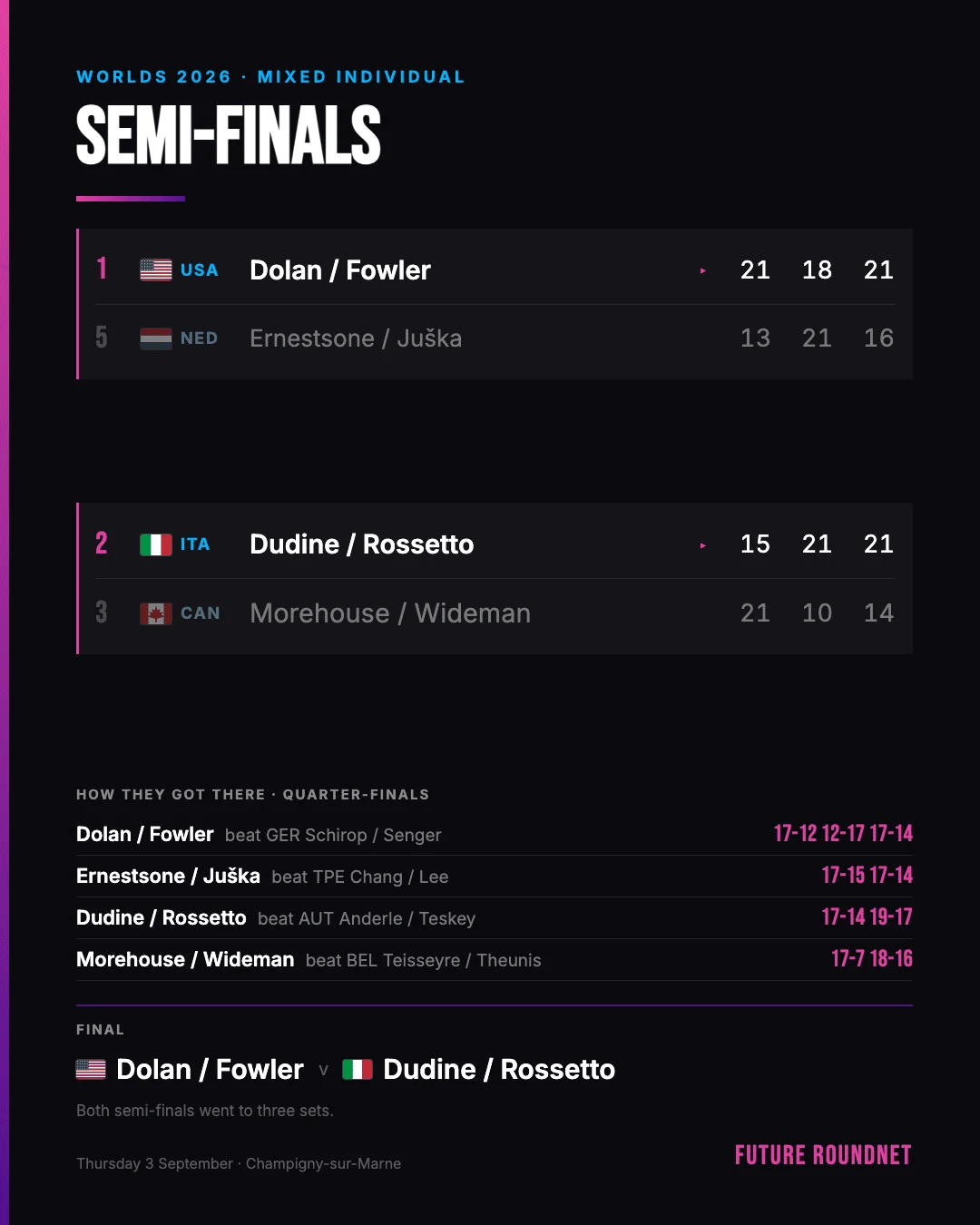
Mixed ran a full round ahead of the other two divisions all day, so it produced the first medals. Ernestsone and Juska of the Netherlands took bronze against Morehouse and Wideman of Canada, 18-16 and 17-15. An hour later Dudine and Rossetto of Italy beat the top seeds Dolan and Fowler of the United States, 21-17, 24-25, 21-12, and took the title.
Before Thursday the medal table of this championship carried six names and had not changed in three editions: the United States, Germany, Switzerland, Austria, Canada and France. It now carries eight. Neither the Netherlands nor Italy had ever won a medal here, and both got one in the same hour, one of them gold.
Close to 500 people were watching the final live on YouTube while it happened, on a Thursday evening in early September.
The full story is in two nations won their first medals in one hour.
2. The day cost 987 games and 27,016 points
Three individual divisions played 987 completed games on day one, across 1,020 sets, for 27,016 points. The squads played none of theirs: 0 of 80 men's matches and 0 of 55 women's.
| Division | Games | Sets | Points |
|---|---|---|---|
| Men's individual | 514 | 521 | 13,860 |
| Women's individual | 350 | 355 | 9,245 |
| Mixed individual | 123 | 144 | 3,911 |
| Total | 987 | 1,020 | 27,016 |
Games and sets are nearly the same number because pool play is a single game: 953 of those 987 were group matches, and only the 34 bracket matches are best of three. The men's first group round alone took 255 games, more than the entire mixed division played all day.
That total is now complete. It was counted while the mixed final was still being played, and the 120 points of that final have been added back in: three games, 21-17, 24-25 and 21-12, the last of the 27,016.
The field behind those numbers is 207 pairs from 36 nations. Mixed is the tidiest division in the championship: 28 pairs from 28 countries, not one nation with two entries.
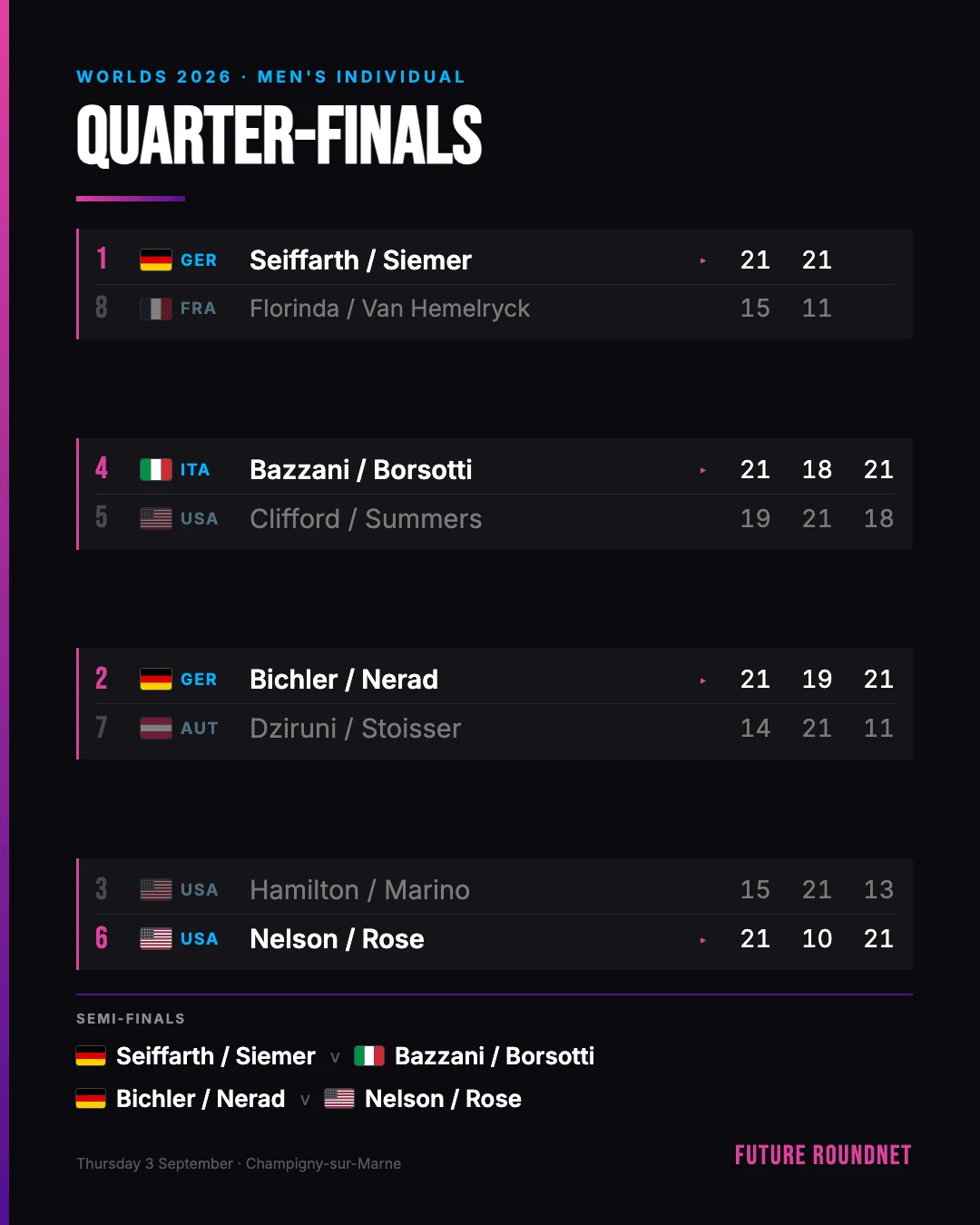
3. Germany had six pairs in the three quarter-finals. Two are left, and both can reach the same final.
Seiffarth and Siemer are seeded first, Bichler and Nerad second, and the draw puts them in opposite halves. Neither can meet the other before Friday's final, which means an all-German men's final is two wins away and needs no upset at all. Seiffarth and Siemer play Bazzani and Borsotti at 14:00; Bichler and Nerad play Nelson and Rose.
The same country's women's campaign ended on Thursday afternoon. Germany put three pairs into the women's quarter-finals, more than any other country, and lost all three.
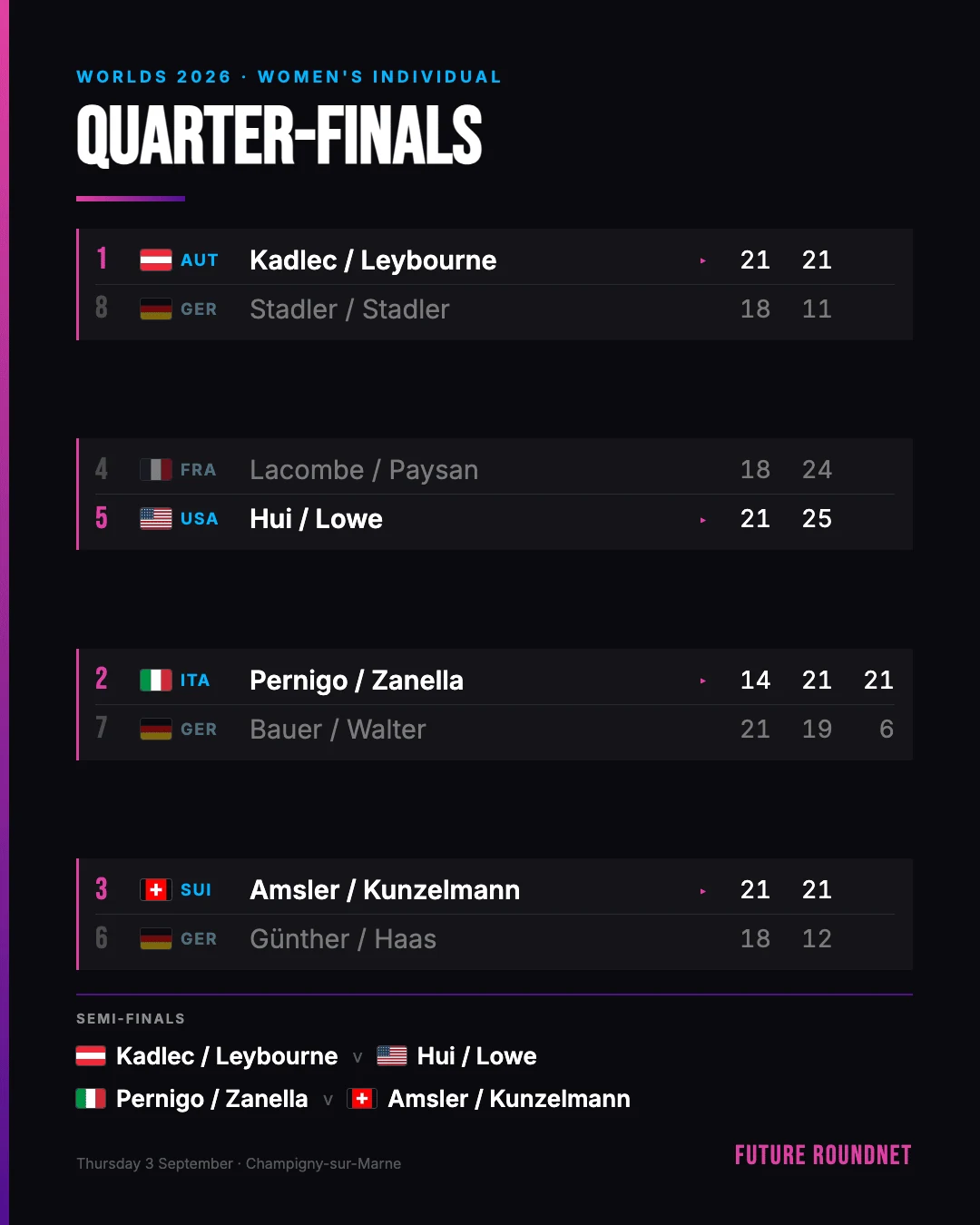
It is not that any of them collapsed. Bauer and Walter, seeded seventh, took the first game off the second seeds Pernigo and Zanella 21-14 and lost the next two. Günther and Haas, seeded sixth, lost 21-18, 21-12 to the Swiss pair Amsler and Kunzelmann. Stadler and Stadler, seeded eighth, drew the top seeds first and went out 21-18, 21-11. That match was a rematch of the 2024 world final, which Kadlec and Leybourne won 21-19, 21-15. Two years on, the same two pairs met again with the same result, except that this time it happened in the quarter-finals. Stadler and Stadler had reached the bracket by a single point of margin, and their reward was the reigning champions in the first round of it.
Six pairs in, two left, and the two that are left could between them take both places in a world final. Same country, same day, opposite directions.
4. The women's last four are four different countries
Austria, the United States, Italy and Switzerland. Kadlec and Leybourne meet Hui and Lowe; Pernigo and Zanella meet Amsler and Kunzelmann. Of the three individual divisions, this is the only one whose semi-finals contain no repeated nation.
5. A quarter-final ended at 25-24, which is the format showing its hand
Hui and Lowe beat Lacombe and Paysan 21-18 and 25-24. That second number is not a typo and it is not sudden death by accident. Bracket games carry a hard cap at 25: at 24-24 the win-by-two rule switches off and the next point takes the game. The fifth seed knocked out the fourth on the last point the format allows.
That was one of exactly three quarter-finals on Thursday won by the lower seed, one in each division: Hui and Lowe over the fourth seeds, Nelson and Rose over the third seeds in an all-American men's tie, and Ernestsone and Juska over the fourth seeds in the mixed. One upset per division, and no more than one.
What is on tomorrow
Friday is the day the individual titles are decided, and the squad competition starts underneath it.
| Time | What |
|---|---|
| 8:30 | Squad pool play, round one |
| 11:30 | Squad pool play, round two |
| 14:00 | Men's and women's individual semi-finals, best of three to 21, hard cap 25 |
| 16:30 | Men's individual final |
| 18:00 | Women's individual final |
| after | Women's and men's podium ceremony, time to be confirmed |
The men's semi-finals are Seiffarth and Siemer against Bazzani and Borsotti, and Bichler and Nerad against Nelson and Rose. The women's are Kadlec and Leybourne against Hui and Lowe, and Pernigo and Zanella against Amsler and Kunzelmann.
Where to watch
Two streams are running:
Live scores, brackets and every group table are on fwango, which is the platform the federation itself points spectators to.
If you want the format explained rather than the scores, the men's cut after pool play is written up in eight pairs finished the deciding round on 4-1, and the pre-tournament ratings are in what the model said before Paris.
FRESH 27 is in Palma, Mallorca in March 2027. If you want to be told when places open, put your name on the list at FRESH.
Corrections: spot something wrong? Write to contact@futureroundnet.com and I will fix it and say so here.
Quick guide: the world championship in brief
In the women's individual: Kadlec and Leybourne (Austria), Hui and Lowe (United States), Pernigo and Zanella (Italy), Amsler and Kunzelmann (Switzerland). In the men's individual: Seiffarth and Siemer (Germany), Bazzani and Borsotti (Italy), Bichler and Nerad (Germany), Nelson and Rose (United States). The mixed final is between Dolan and Fowler (United States) and Dudine and Rossetto (Italy).
On Friday 4 September. The men's and women's individual semi-finals both start at 14:00, the men's individual final is at 16:30 and the women's individual final at 18:00, with the podium ceremony afterwards. Squad pool play runs the same morning at 8:30 and 11:30. The squad finals follow on Sunday.
Two streams are running: one on YouTube and one on the Roundnet Germany channel on Twitch. Live scores, brackets and every group table are published on fwango, which is the platform the International Roundnet Federation points spectators to.
The field is cut into consecutive blocks of eight by final ranking, and each block plays its own knockout for those places. Every pair reaches a quarter-final; only the top block has medals behind it. The eight in that block are the six winners of the second pool round plus the two best runners-up, seeded by fewest defeats and then by points margin.
A hard cap removes the win-by-two requirement at a set score. Under the IRF ruleset, a game with a hard cap at 25 is decided by the next point once the score reaches 24-24. Pool play in Paris ran as a single game to 17 with a hard cap at 17; the medal bracket plays best of three to 21 with a hard cap at 25. That is why a quarter-final could finish 25-24.
At the Parc Interdepartemental des Sports du Tremblay in Champigny-sur-Marne, near Paris. It runs from 3 to 6 September 2026 and is the third edition of the championship, after 2022 and 2024.