
The third Roundnet World Championship is being played this week at Parc du Tremblay in Champigny-sur-Marne, the first on French soil, with one hundred and five pairs in the open division drawn into eighteen groups.
Two years ago in Guildford every individual title changed hands and none of them stayed in the United States. Germany took the men's, Austria the women's, Switzerland the mixed. The American squad titles held. The medal record going into this week reads twelve for the United States, and four for everybody's best single nation behind them.
Before the first serve, Federico Grazi ran the open division through his rating system: every player carries a number, every pair is the sum of its two, and the tournament is simulated many times over until each pair has a probability attached to every finishing place. He sent me the output, timestamped the first of September at midday.
A big thank you to Federico Grazi. He built this for a sport with no statistics department and no budget for one, and he did it because he wanted the numbers to exist. Roundnet is better off for people like him.
One thing before the numbers. I have seen and know every player on this list personally: some from the last world championship, some from my travels and playing years in the United States, some from their time at FRESH or the Mallorca Open. They are all high quality players and, every one of them, great humans. The numbers below rate them. They do not describe them.
The question this week answers: whether the concentration the model sees at the very top is real, or an artefact of a rating system looking at a sport whose best players rarely meet.
The one number
63.1 percent. That is the share of simulated tournaments won by a single pair, out of a hundred and five. Three pairs hold 87.4 percent of the gold between them. Six hold 96.9. Eighty-seven pairs have a medal chance the model records as zero.
Movement since Guildford
Of the eight contenders below, four contain a player with a world championship medal already, and the pair at the top of the list are squad gold medallists together. One contains a reigning individual champion. Three contain nobody our record of the first two championships carries at all.
Who the model does not know
Twenty-four pairs have both players sitting on the default rating of 1,200, the value assigned when the system has no results for someone. Another eighteen have one player on the default. For those forty-two pairs the model is not making a weak prediction, it is making an uninformed one.
What would count as an upset
A gold for anyone outside the eight below. Across all one hundred and five pairs the model allows that 0.8 percent of the time.
The contenders
Eight pairs, ranked by the model's medal probability. The same five numbers for each: team rating, gold, any medal, reaching the last eight, reaching the final.
| # | Pair | Rating | Gold | Any medal | Last eight | Final |
|---|---|---|---|---|---|---|
| 1 | 🇺🇸 Connor Nelson & Kieran Rose | 3,912 | 63.1% | 83.2% | 91.0% | 74.2% |
| 2 | 🇺🇸 Thomas Hamilton & Ryan Marino | 3,692 | 13.5% | 51.5% | 77.6% | 34.3% |
| 3 | 🇺🇸 Paq Clifford & Jacob Summers | 3,667 | 10.8% | 46.5% | 75.4% | 29.8% |
| 4 | 🇨🇦 Etienne Cote & Je Gagnon | 3,550 | 3.4% | 25.8% | 63.0% | 14.2% |
| 5 | 🇮🇹 Nicola Bazzani & Andrea Borsotti | 3,551 | 3.5% | 25.6% | 62.5% | 14.2% |
| 6 | 🇩🇪 Georg Seiffarth & Paul Siemer | 3,548 | 2.6% | 20.8% | 57.3% | 11.2% |
| 7 | 🇩🇪 Tim Bichler & Kasimir Nerad | 3,488 | 1.7% | 17.2% | 55.5% | 8.9% |
| 8 | 🇩🇪 Emil Gronebaum & Rasmus Prufer | 3,399 | 0.5% | 7.4% | 42.0% | 3.5% |
#1 🇺🇸 Connor Nelson & Kieran Rose
Rating 3,912 · Gold 63.1% · Any medal 83.2% · Last eight 91.0% · Final 74.2% Worlds record: both won men's squad gold with the United States in 2024. Rose also took mixed silver at the same championship.
The model does not see a contest at the top. Nelson and Rose are rated 220 points clear of the second pair, in a field where the gap from second to third is twenty-five.
For them: Nelson carries the highest individual rating in the entire field at 2,045, and Rose at 1,867 is the fourth-highest. No other pair has two players inside the top four. They already own a world championship gold together, on the American men's squad in Guildford. The 74.2 percent chance of simply reaching the final is higher than any other pair's chance of a medal of any colour.
Against them: 63.1 percent for gold also means that more than one time in three, they do not win it. Their internal gap of 178 points is the second-largest in this eight, which means the model leans harder on Nelson than the pair's combined number suggests.
What to watch: whether Rose plays at the level his mixed silver implies. He is the swing factor in the strongest pair in the tournament.
Where to find them: Group A, first seed.

#2 🇺🇸 Thomas Hamilton & Ryan Marino
Rating 3,692 · Gold 13.5% · Any medal 51.5% · Last eight 77.6% · Final 34.3% Worlds record: Hamilton, men's bronze 2022 (USA). Both on the USA 2024 squad.
Second on rating, second on every probability that matters, and the only pair besides the favourites the model gives a better than even chance of a medal.
For them: Hamilton has been on a world championship podium and on the American squad at both editions, which no other player in this eight can say. At 51.5 percent, a medal for this pair is closer to a coin flip than to a hope.
Against them: 13.5 percent for gold against the favourites' 63.1. The model has them silver more often than gold, 20.8 against 13.5, which is a polite way of saying it expects them to meet Nelson and Rose and lose.
What to watch: whether they end up on the same side of the draw as the favourites. Everything about their medal colour depends on it.
Where to find them: Group F, first seed.
#3 🇺🇸 Paq Clifford & Jacob Summers
Rating 3,667 · Gold 10.8% · Any medal 46.5% · Last eight 75.4% · Final 29.8% Worlds record: neither name appears in our record of 2022 or 2024.
Twenty-five points off second, and the most evenly matched pair in the tournament: 1,834 and 1,833, one point apart.
For them: that one-point gap is the smallest of any contender here, against 506 for the widest. A pair with two players of the same level has no weak side to attack, which matters in a format that gives every player the same two serves and the same number of serves against each opponent, so a weaker partner can be neither hidden nor hunted from the service line.
Against them: no championship record at all. Our record of both world championships is complete for medallists and for the squads of every nation that reached a podium, and neither name is in it. The rating is built on results elsewhere.
What to watch: their first match against a seeded opponent. This is the pair the model rates and the championship record does not, and one of the two is about to be wrong.
Clifford coached at FRESH 26. That is not a rating and it has no business in the model, but I got to spend a week watching him teach the game, and nothing in that week suggested he had found his ceiling.
Where to find them: Group G, first seed.
#4 🇨🇦 Etienne Cote & Je Gagnon
Rating 3,550 · Gold 3.4% · Any medal 25.8% · Last eight 63.0% · Final 14.2% Worlds record: Cote, men's silver 2024 (CAN). Both on the Canadian 2024 squad.
The best-placed pair from the nation that has finished second in the men's squad at both championships.
For them: Cote has already played a world championship final, losing the 2024 men's title to Germany in three sets. Ten points separate these two players, the second-smallest gap in this eight.
Against them: the drop from third to fourth is where the model's cliff is. Clifford and Summers are 117 rating points ahead, and that translates into a gold chance three times larger, 10.8 against 3.4.
What to watch: whether Canada's habit of arriving second turns into something else. The model gives them bronze more often than silver, 11.6 against 10.8, the first pair on this list where that is true.
Where to find them: Group H, first seed.
#5 🇮🇹 Nicola Bazzani & Andrea Borsotti
Rating 3,551 · Gold 3.5% · Any medal 25.6% · Last eight 62.5% · Final 14.2% Worlds record: neither name appears in our record of 2022 or 2024.
Rated one point above Cote and Gagnon and placed one rank below them. The two pairs are, to the model, the same team.
For them: at 3,551 they are 84 points ahead of the seventh contender and 152 ahead of the eighth. The gap behind them is far wider than the gap in front.
Against them: their 62.5 percent chance of reaching the last eight is the lowest of the top five, and the 3.5 percent gold chance is a twentieth of the favourites'. Like Clifford and Summers, they carry no championship record for the rating to lean on.
What to watch: the group stage. At 99.7 percent to reach the last thirty-six they are safe, but their path narrows fast after that.
I had the chance to see both of them in Mallorca, at the tournament and at FRESH. They are the clearest case on this list of a rating built somewhere the world championship record cannot look.
Where to find them: Group E, first seed.
#6 🇩🇪 Georg Seiffarth & Paul Siemer
Rating 3,548 · Gold 2.6% · Any medal 20.8% · Last eight 57.3% · Final 11.2% Worlds record: Siemer, men's gold 2024 (GER). Both on the German 2022 squad, Siemer also 2024.
The reigning men's world champion is sixth, and the reason is not form. It is the shape of the pair.
For them: Siemer's individual rating of 2,027 is the second-highest of any player in the field, behind only Nelson. He is the only reigning individual champion in this eight, and he won that title from a set down.
Against them: the 506-point gap between Siemer and Seiffarth is the largest internal gap of all one hundred and five pairs in the draw. Nobody is more lopsided. The serve rotation is fixed, so no opponent can decide to aim at the weaker half of the pair, and whatever the gap costs has to be taken in open play. The model prices it anyway: 2.6 percent for gold against 63.1 for the favourites, despite a team rating only 364 points lower.
What to watch: how often opponents simply refuse to play the ball to Siemer. If Seiffarth holds up under that, the model is wrong about this pair, and it is wrong by a lot.
Where to find them: Group B, first seed.
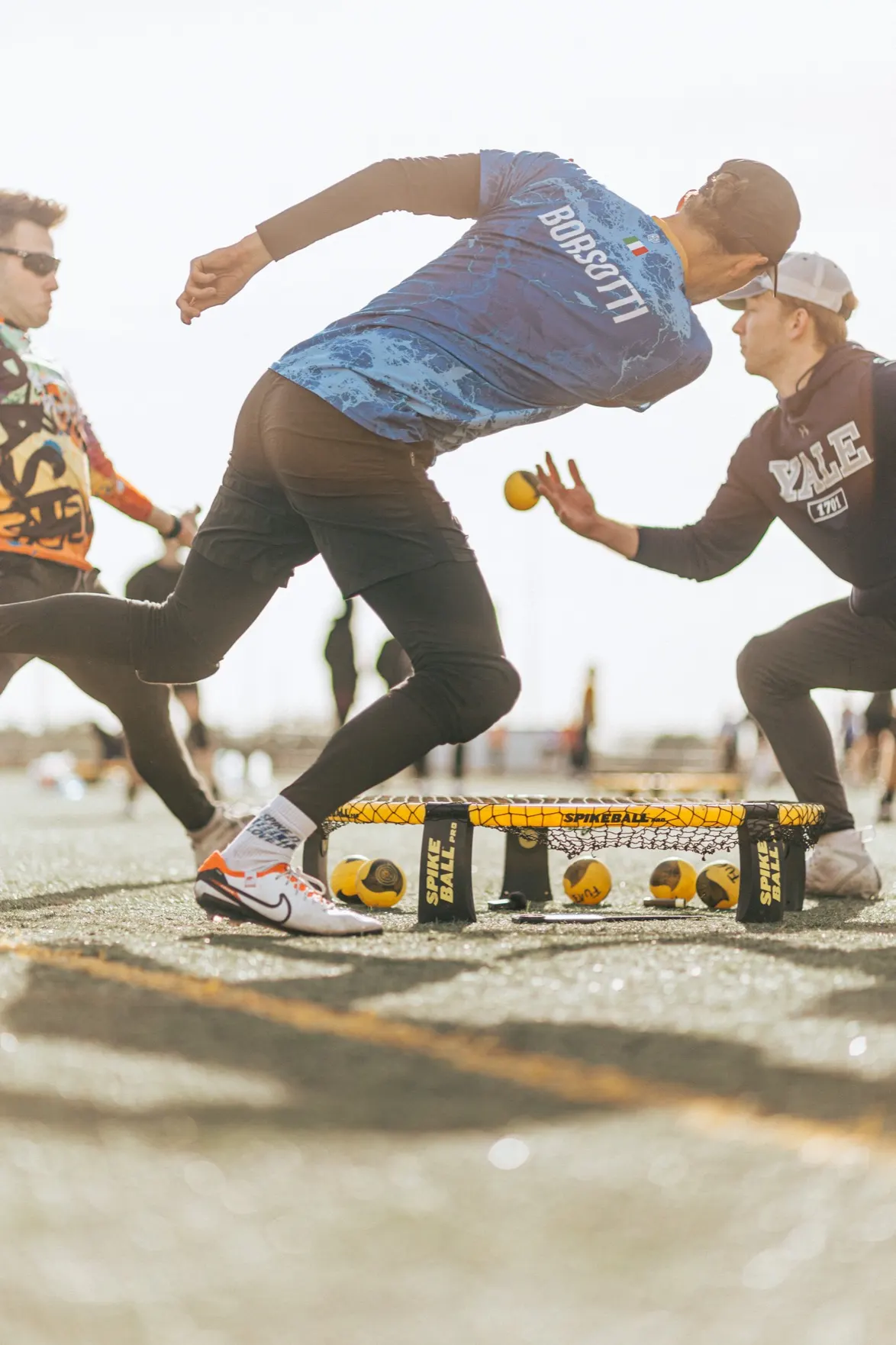
Fun fact. Siemer won that 2024 title with Lukas Eisenträger, not with Seiffarth. The picture above is Eisenträger on 10 March 2024 at the Mallorca Open, the tournament that runs as part of FRESH, attacking in a jersey with somebody else's name across the back. Defending him: Fredric Hinkle and Max Model, both on the United States men's squad that took squad gold in 2022, Hinkle with a men's silver of his own from the same championship. Five and a half months later Eisenträger was world champion.
#7 🇩🇪 Tim Bichler & Kasimir Nerad
Rating 3,488 · Gold 1.7% · Any medal 17.2% · Last eight 55.5% · Final 8.9% Worlds record: neither name appears in our record of 2022 or 2024.
The last pair the model gives a better than even chance of reaching the last eight.
For them: 55.5 percent to make the quarter-finals, against 42.0 for the pair immediately behind them. That 13-point drop is the widest single step anywhere in this eight, and they are on the right side of it.
Against them: 1.7 percent for gold. Their most likely single outcome is not a medal at all but fourth place, at 9.7 percent, the highest fourth-place probability of any contender. The model has them arriving and then stopping.
What to watch: the quarter-final, if they get there. Everything in their profile says they reach it and nothing says they pass it.
Both have been to FRESH twice, and they have had a season in Europe that I would call outstanding. What I remember from the camp is the two of them hanging around with Clifford and with the American Kyle Fowler, a lot. Seeing them turn up in a group like this one is a good thing to watch.
Where to find them: Group D, first seed.
#8 🇩🇪 Emil Gronebaum & Rasmus Prufer
Rating 3,399 · Gold 0.5% · Any medal 7.4% · Last eight 42.0% · Final 3.5% Worlds record: neither name appears in our record of 2022 or 2024.
The eighth contender, and the first pair where the model expects an early exit more often than a deep run.
For them: Prufer at 1,792 is the eighth-highest individual rating in the field, and he is rated above at least one player in five of the seven pairs ranked ahead of him. On his side, this is contender material.
Against them: 42.0 percent to reach the last eight means the model has them out before the quarter-finals more often than in. Their 185-point internal gap is the largest here after Seiffarth and Siemer.
What to watch: Prufer's results against the seeded pairs. He is the argument for this pair being underrated, and the group stage will settle it.
Where to find them: Group C, first seed.
Predictions by Levi Vandaele
🇧🇪 Levi Vandaele is one of the hundred and five in the open draw, eleventh on the model's own list, the 2024 ETS champion, and a three-time FRESH alumnus. He posted his picks on Discord. These are his three for the open individual, the division the model above covers:
| Open individual | |
|---|---|
| 1 | Kieran / Connor |
| 2 | Borsotti / Bazzani |
| 3 | Willy Wonka |
Two things stand out against the numbers above. Vandaele has the same pair first that the model gives 63.1 percent, which is the easy agreement. But he puts Borsotti and Bazzani second, where the model has them fifth at 3.5 percent for gold, behind two American pairs. A player who has met them picks them three places higher than a rating system that has never seen them play.
The model and the player disagree, and the disagreement is the interesting part.
Correction, 3 September 2026: two sentences in this article said the serving side chooses which opponent to serve at. It does not. Every player has two serves and the rotation gives every player the same number of serves against each opponent, so no pair can be targeted from the service line. Both sentences have been rewritten. The ratings, probabilities and the eight selected are unchanged.
This is a forecast, not a report. It was fixed before the first serve on 1 September 2026 and it does not update, so that when the championship is over it can be read against what actually happened. A model that gives one pair 63 percent is also saying that better than one time in three, somebody else wins.
Results, draws and live standings are on the tournament platform: Roundnet World Championship 2026 on fwango.
The record both previous championships have already written is in my companion piece: eight things the record already decided.
The ratings and probabilities in this article come from a model built and run by Federico Grazi. The simulation is his work. The cross-checks against the 2022 and 2024 championship record, the selection of the eight, and any errors here, are mine.
Corrections: spot something wrong? Write to contact@futureroundnet.com and I will fix it and say so here.
Quick guide: the world championship in brief
According to a rating model run by Federico Grazi before the tournament began, Connor Nelson and Kieran Rose are the clear favourites. The model gives them a 63.1 percent chance of gold and an 83.2 percent chance of a medal of some colour, out of a field of 105 pairs. Their rating of 3,912 is 220 points clear of the second-placed pair, and that gap is the single biggest factor in the forecast.
One hundred and five pairs, drawn into eighteen groups: three groups of five and fifteen groups of six. The championship is held at Parc du Tremblay in Champigny-sur-Marne near Paris from 2 to 6 September 2026.
The model gives fifteen of the 105 pairs a medal chance above one percent, and records a zero chance for eighty-seven of them. Three pairs hold 87.4 percent of the gold between them: Nelson and Rose, Hamilton and Marino, and Clifford and Summers. All fifteen contenders are the first seed in their group, so the seeding and the model agree on who belongs at the top.
No. Paul Siemer, who won the men's title in Guildford in 2024, has the second-highest individual rating in the field at 2,027, but the model puts his pair sixth for gold at 2.6 percent and 20.8 percent for any medal. The reason is arithmetic rather than form: the system rates two players and adds them together, so a pairing is only as strong as both ratings that go into it.
Each player carries a rating derived from their past results. A pair's rating is the sum of its two players, and the tournament is then simulated many times over to produce a probability for each finishing place. Four limits apply here: twenty-four pairs have both players sitting on the default rating of 1,200, meaning the system has no results for them; the model cannot see form, injuries or how long a pair has played together; it does not account for a home crowd; and these files cover the open division only, not women's or mixed.
Draws, standings and live results are published on the tournament platform fwango. The forecast in this article is a fixed snapshot taken before the first serve on 1 September 2026 and is not updated during the championship.